
Storing Fat, Low Skill Conditioning & Shoulder Pain
Why Am I Storing Fat In My Legs & Hips? (F)
I used to subscribe to Charles Poliquin's theory on this - that typically, women store more body fat in the lower body because 1) they are storing DHA for pregnancy / breast feeding and 2) their diet is typically quite low in it, hence why it’s trying to store more of it… I’m paraphrasing obviously, and while it does make some sense, current research doesn’t really support DHA deficiency as a primary cause of women storing fat around the hips and thighs…
Fat distribution is largely determined by hormones, genetics, and overall energy balance. I think DHA plays more of a supportive role in overall metabolic health - so do make sure you’re getting some oily fish / supplementing if low - but I don’t think DHA is the main player.
I wish I could say “take some fish oil and your problem will be solved” but sadly it’s not that easy - instead I have to say “get some testing done - bloods, nutrients, hormones - that will put you on the right track.”
If you need help, I know a guy. (A doctor…)
Last Night's Magic
(Low Skill + No Eccentric = Pure Magic)
Last night - Friday 10th July 2026 S&C class - the format went something like this…
- The floor is lava
- Breathing & Bracing
- Psoas Raises
- Build To Heavy Farmers Walk
- A Low Skill, Low Eccentric Conditioning Piece
The conditioning piece was a partner workout. 6 Rounds for time (3 each) of:
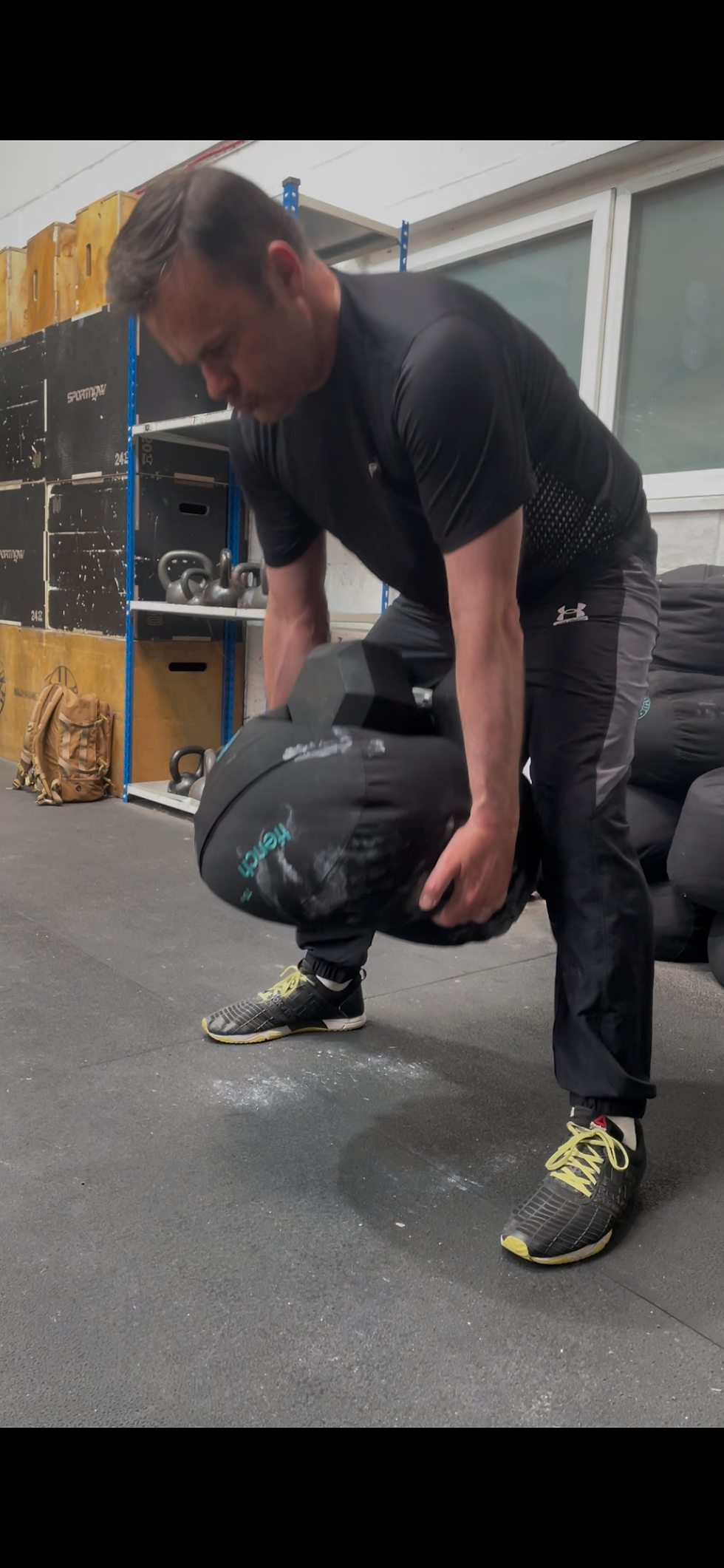
- Half a length sandbag flip
- Sandbag carry to the end and back
- 10/7 calorie airbike
The goal for the conditioning piece was to feel the glutes and hamstrings and get the heart and lungs working.
Here’s why it worked…
Low skill: High-skill movements limit the intensity you can sustain, while low-skill allows you to push much harder with significantly less risk and a reduced chance of building ‘questionable’ movement patterns (that the correct movement pattern will then have to compete with later)
Low eccentric: Eccentric movements - the phase of the movement where the muscle lengthens under tension - increase muscle damage and fatigue. By removing that phase we can significantly reduce delayed onset muscle soreness (DOMS) and injury risk, while keeping the training stimulus high.
Low weight bearing: There’s some weight on the structure with sandbag carries, but the flips (great for glutes and hammies, btw) and the airbike have none. Exercises with less load on the body’s structure are typically far safer and allow for greater effort / intensity with less chance of injury.
Phrased another way, a workout designed like this allows you to train really, really hard and reap all the benefits with none of the soreness, risk, niggles, tweaks, nervous system fatigue, etc that usually comes with hard training…
* For those in the know, “Phish Food” has no eccentric and is low skill, with low to moderate weight on the structure… The Prowler (sled) too, only it’s even better because there’s no weight on the structure… ;)
Yes there are benefits to the eccentric phase and loading the structure, and yes you need skill work, and yes, in CrossFit you may need to demonstrate skill while fatigued, but there’s a time and a place… Ya know!?
Pain In The Front Of The Shoulder When Pressing
Typically weakness or poor neural output of the pec major tends to lead to tension displacement in the front of the shoulder. In a way, it’s good that you caught it early, because it can progress towards overuse of mid-trapezius and supraspinatus, causing forward shoulder rolling in pushing movements, resulting in upper trapezius dominance or inflamed supraspinatus (more pain elsewhere and a longer recovery, basically). Build the connection, lengthen and strengthen pec major, and things should start to fall into place for you.
As always, if you need help, come find me!
Cheers,
~ Collins

Neil Collins is a personal trainer and movement specialist based in Haywards Heath. With over 15 years of experience, he helps people overcome pain, improve the way they move, and build functional strength and impressive skills.


Comments